
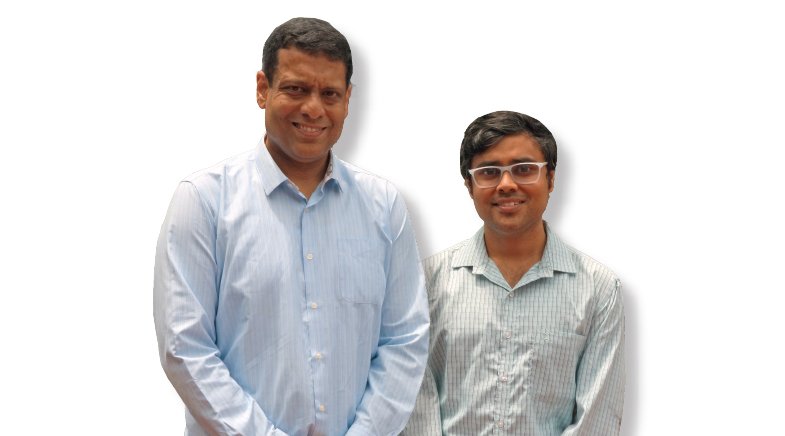
Kaushik Chatterjee of the Indian Institute of Science (IISc) worked on tissue reengineering using biodegradable materials during his postdoctoral research at the National Institute of Standards and Technology in the U.S. Indranil Chakraborty, who was a postdoctoral researcher in Chatterjee’s IISc laboratory and then joined the private sector, suggested they come together to make orthopaedic implants. Chatterjee, currently the Chair of the Department of Bioengineering at the IISc, had completed his PhD in Bioengineering from Penn State College of Medicine; Chakraborty had earned his doctorate in Inorganic Chemistry from the S.N. Bose National Centre for Basic Sciences in Kolkata.
Chatterjee and Chakraborty established MedrinZ BIO, a start-up incubated at the Foundation for Science Innovation and Development, to develop orthopaedic implants using 3D printing. The researchers came into contact with a clinician at a government hospital in Bengaluru who was seeking an engineering partner to develop 3D-printed bone implants for corrective surgeries. Chatterjee’s research group collaborated with the doctor and customised implants for his patients. These implants have been used for more than a dozen patients, Chatterjee says. “We have one year of follow-up data, and we recently published a paper,” he adds.
The company is developing implants with bone scaffolds to repair irregular defects and 3D-printed polymer scaffolds to self-fit into irregular and complex tissue defects to promote bone growth as well as resorbable orthopaedic implants. To begin with, they focused on conventional materials used in orthopaedic applications but innovated the manufacturing technique. “As a materials lab, we are trying to find the right balance between something that is not too high a risk for the patient and one that offers significant benefits over conventional technology,” says Chatterjee.
It plans to use soft polymers and soft gels for regeneration purposes. The team is working on advanced fracture fixation and bone reconstruction using absorbable alloys that degrade safely within the body after the bone has regenerated.
Chakraborty says the company has partnered with a manufacturing company to produce the implants. The first product, utilising titanium, is expected to be released by the end of 2025, and products featuring soft polymers and gels are slated for launch in approximately two years. The orthopaedic implants market is substantial and growing at a steady pace annually — the market in 2023 was estimated at ₹55,000 crore and growing at 8% CAGR.